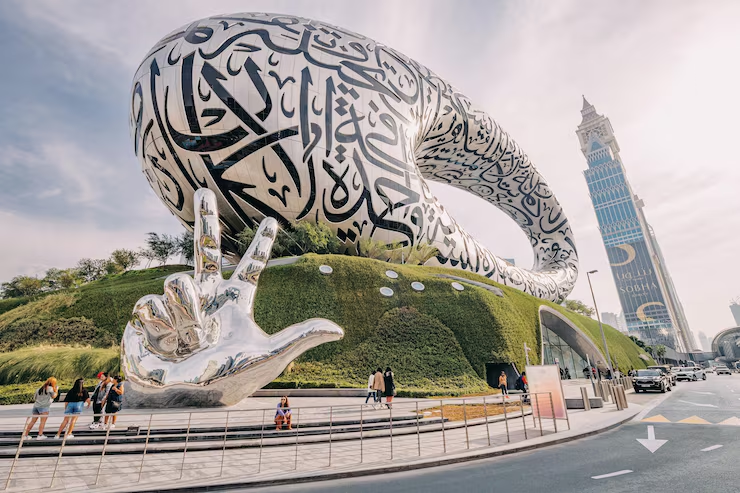
One of the most iconic landmarks in Dubai is the Museum of the Future. It delves into how science and technology might influence the future, whether in space exploration, health, or the environment, through immersive environments, interactive installations, and storytelling.
The museum has been open since 22 February 2022 and has already served over 5 million people since then, according to Khaleej Times.
In this guide, we will tell you everything you need to know: why the museum is closed and when it is going to reopen, what you could find inside, where it is, how tickets and prices work, visitor rules, accessibility, and useful tips. Information before the closure is clearly identified as to what is confirmed or what may change.
The Museum of the Future is an innovative museum in Dubai that explores how science, technology, and everyday life may evolve over the coming decades. Located along Sheikh Zayed Road, it is one of the city’s most distinctive architectural landmarks, recognised for its silver, ring-shaped structure decorated with Arabic calligraphy.
Unlike traditional museums, which mainly display historical objects, the Museum of the Future offers an interactive experience where visitors can explore ideas about what tomorrow might look like. Its exhibitions feature immersive digital environments, artificial intelligence, space exploration, future healthcare, climate change, and emerging technologies.
The museum brings together science, creativity, design, and innovation to encourage visitors to imagine how future generations might live, work, travel, and interact with the world.
The idea behind the Museum of the Future first emerged during the World Government Summit in 2014, where Dubai’s leadership explored ways to bring future-focused innovation and technology into public life.
On 3 March 2015, His Highness Sheikh Mohammed bin Rashid Al Maktoum officially announced the Museum of the Future project. The initiative aimed to establish Dubai as a global centre for innovation, scientific research, and future technologies. The Dubai Future Foundation was established in 2016 to support the development of future-focused projects and initiatives.
Construction began in 2017, with advanced engineering techniques and 3D printing technologies used to create its unusual structure. The building’s main steel framework was completed in November 2018, while the complex façade required extensive robotic manufacturing and precision engineering.
The museum was officially inaugurated on 22 February 2022 by Sheikh Mohammed bin Rashid Al Maktoum, marking the opening of one of Dubai’s most recognisable landmarks
| Detail | Information |
|---|---|
| Current status | Temporarily closed since 1 September 2026 |
| Expected reopening | First quarter of 2027, around the museum’s fifth anniversary (exact date not yet announced) |
| Attraction type | Immersive museum about science, technology, and the future |
| Location | Sheikh Zayed Road, Trade Centre 2, next to Jumeirah Emirates Towers, Dubai |
| Nearest metro | Emirates Towers Station (Red Line), linked to the museum by a bridge |
| Building | 77 m tall, 7 floors, no internal columns, designed by Killa Design |
| Main themes (before closure) | Space, nature and biodiversity, well-being, near-future technology, children’s learning |
| Recommended visit time (before closure) | About 2 to 3 hours |
| Last ticket price (before closure) | AED 169 per person, age 4 and above |
| Free entry (before closure) | Children under 4; people of determination plus one caregiver |
| Booking | Timed tickets were required. Tickets for the new experience will go on sale closer to reopening. |
| Official website | museumofthefuture.ae |
Yes. The Museum of the Future is closed but is scheduled to reopen.
According to the museum’s official website, the museum is “temporarily closed as we prepare for our next chapter. The closure is temporary and not permanent.
The museum was designed to change over time. It is not a traditional museum with fixed exhibits, but it changes exhibits to reflect new concepts in science and technology.
This closure is its biggest overhaul since opening. The museum’s FAQs state that no reversion to the old exhibitions will take place.
Each will be updated with something new, linked by a new story and a new walk around the building.
The museum also states that the new experience is partially influenced by over a thousand suggestions it received from the worldwide public.
The museum is expected to reopen in the first quarter of 2027, approximately five years after its opening on 22 February 2022. An exact date has not been announced yet.
Key dates so far:
Tickets for the new experience will be available closer to the museum’s reopening, according to the museum. There are no new prices available. Beware of any website that tries to offer dates during the closure.
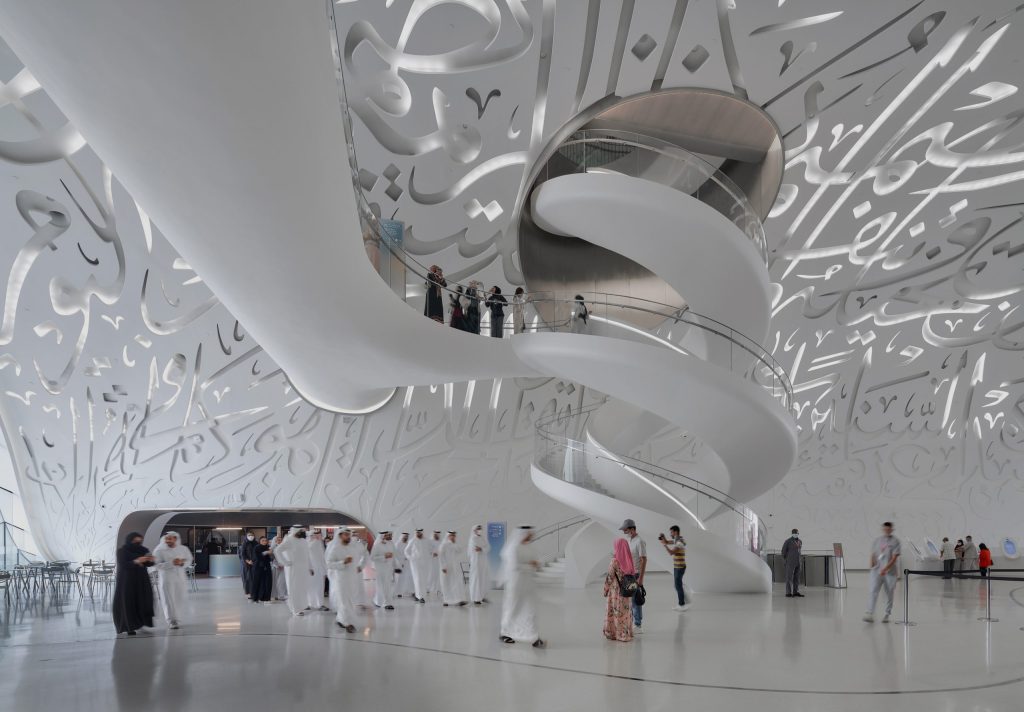
Prior to closure, the museum guided visitors through the year 2071 on a story journey. The visitors began at the top and proceeded down the building level by level. The floors were each “chapters” with a different theme and character.
The five main areas of the journey were
The building also has an events hall, an auditorium, and a lobby with a shop and café.
Things will be very different when it opens in 2027.
The museum has pledged new exhibitions, interactive spaces, and new laboratories, and the public will be more engaged in learning about science and research. More information is not available at this time.
The Museum of the Future is best known for its unique design. At its opening, Dubai’s ruler Sheikh Mohammed bin Rashid Al Maktoum called it “the most beautiful building in the world.”
What makes the building special:
The building is 77 meters tall, 7 floors high, and 30,548 m² in size. Designed by Killa Design (architect Shaun Killa), the project was engineered by Buro Happold. The total surface area of the steel façade is approximately 17,600 m².
There will be no changes to the exterior of the building during the current renovation, and it will continue to be one of the city’s most photographed landmarks.
Yes, for most visitors, but not right now; you can only experience it from the outside. The exhibitions will not reopen until 2027, so your answer will be based on the date you travel.
The Museum of the Future is on Sheikh Zayed Road in the Trade Centre 2 area, right next to Jumeirah Emirates Towers.
It is located in Dubai’s financial district, near DIFC (Dubai International Financial Centre), and is only a short distance from Downtown Dubai.
Address: Sheikh Zayed Road, Trade Centre 2, Dubai, United Arab Emirates (P.O. Box 66610).
The Red Line can also be used to get to Emirates Towers directly from Dubai International Airport (Terminals 1 and 3) without changing trains
Near Emirates Towers are RTA bus routes 27, 29, and X22.
The distances shown below are approximate straight-line distances. The roads are longer and taxi travel time varies according to traffic.
| From | Approx. distance | Easiest way to get there |
|---|---|---|
| The Dubai Mall | About 2.3 km | Metro: Emirates Towers to Burj Khalifa/Dubai Mall Station is 2 stops on the Red Line, then follow the covered walkway to the mall. Or a short taxi ride |
| Burj Khalifa | About 2.6 km | Same metro route as The Dubai Mall, since Burj Khalifa is next to the mall. Or a short taxi ride |
| Dubai Frame (Zabeel Park) | About 2.6 km | Taxi is usually the simplest option |
| Dubai International Airport | About 8 to 9 km | Metro Red Line direct to Emirates Towers, or taxi |
To reach the Museum of the Future from The Dubai Mall: Walk to Burj Khalifa/Dubai Mall Metro Station via the covered walkway of the Dubai Mall, then transfer to the Red Line, which goes towards Centrepoint, and alight at Emirates Towers. The museum is on the other side of the link bridge. It is not feasible to walk all the way down Sheikh Zayed Road, particularly in summer.
There are seven floors in the building. Prior to the closure, there were five floors used for exhibitions and the rest of the floors for events and operations.
Visitors walked in through the lobby on the ground floor, then went up to the top exhibition floor and then down to the exit.
The table below shows the layout as it was before September 2026. The new layout for 2027 has not yet been revealed, and the museum has stated that visitors will take a different route.
| Floor | What was there (before closure)? | Best for |
|---|---|---|
| Level 7 | Events and terrace space (unavailable during the closure) | Events only |
| Level 6 | Events space | Not part of the standard visit |
| Level 5 | OSS Hope: a simulated launch to a space station in 2071 (start of the journey) | All ages |
| Level 4 | Heal Institute and the Vault of Life: Nature, Biodiversity, and Restoring Ecosystems | All ages, photography |
| Level 3 | Al Waha: a calm space for well-being and the senses | Adults, anyone wanting a quiet break |
| Level 2 | Tomorrow Today: real prototypes and near-future technology | Teens and adults |
| Level 1 | Future Heroes: a play-based learning zone | Children under 10 |
| Ground floor | Lobby, entrance, ticket desk, retail shop, and café | Everyone |
Visitor map: A map of the new experience is not yet available. See the official website for updates nearer to reopening for the new layout.
This section outlines the exhibitions that visitors could experience from 2022 up to 1 September 2026. These experiences have now been taken down.
They are included for your information because they give you an idea of the kind of museum the building housed and the quality of the experience it provided. In 2027, they will not be the same.
The first experience of the visit was a simulated space shuttle ride, which took visitors from Dubai to the Orbital Space Station (OSS) in the year 2071.
Inside, they would be able to experience how humans could live and work in space, harvest energy from orbit, and study the planet below. Visitors can wear virtual spacesuits and participate in missions with smart wristbands.
What made people love it: It was quite often the first part of the visit they remembered, and it put the rest of the trip on a high.
This floor envisioned a future research center dedicated to the repair of damaged ecosystems. The visitors were able to walk through a digital, mixed reality recreation of the Amazon rainforest and view details that would normally be hidden from sight.
The show’s star was the Vault of Life, a digital library of glowing representations of the DNA of over 2400 species. The animals in colorful shapes seemed to be floating in colored glass tubes.
What people really enjoyed: One of the most interesting rooms to look at and one of the most popular photo locations.
The Arabic name Al Waha translates to “the oasis. This was a quiet, softly lit, well-being area where visitors were invited to turn their backs on screens and their senses to light, sound, and gentle activities.
Why people loved it: It offered a quiet break between the busier floors.
This floor took visitors back to the present day. It presented over 50 prototypes and actual products that will address future challenges in health, transport, energy, cities, and daily life.
What made it popular: The ideas were realistic and close to everyday life, and they were appealing to adults and older children alike.
Future Heroes was a full floor for children under 10. It involved missions, role-play, teamwork, and physical challenges to develop skills including creativity, communication, and problem-solving.
Why parents loved it: They could allow younger children to play and learn in a space designed for them.
People didn’t only come to see the exhibitions. These are some of the additional features that are worth of note:
Photography hint: enter the gardens to capture the entire ring and the calligraphy. The calligraphy is lit at night, which creates a completely different effect.
Current status: closed. There are no opening times for the exhibitions until reopening in 2027. The museum will announce new hours nearer to reopening.
Where to find the latest schedule: The official website or the official social media sites of the museum. Avoid third-party websites, as many are still displaying old timings.
Before the closure, visitors spent 2-3 hours on the entire experience.
The new 2027 experience may take a different amount of time. Check visitor information when the museum reopens.
Currently, there are no tickets available. Tickets for the new experience will be released nearer to the reopening in 2027, the museum says, and no new prices have been announced.
These are the prices that the museum used to charge before it closed. They provide a rough estimate of the reopening cost, but the actual number may vary.
| Ticket type | Last known price | What it included |
|---|---|---|
| Entry Ticket (age 4 and above) | AED 169 | Timed entry to all main exhibition floors on a set date and time |
| Pioneer Pass | From AED 399 | Arrive any time during opening hours on your chosen date, get priority entry, and get an AED 50 credit for the lobby shop (same day only) |
| Children under 4 | Free | An entry ticket is still needed; it was collected at the Customer Service Desk. |
| People of Determination + 1 caregiver | Free | Entry tickets collected at the customer service desk with valid ID |
Estimated cost: As a general guideline, expect to pay AED 169 per person, based on the most recent published price until new prices are announced.
For the time being, no booking is possible. As tickets for the new experience go on sale, the best place to purchase them will be from the official Museum of the Future website.
Tickets were also sold on Visit Dubai’s official experiences platform and authorized resellers before the closure.
The museum may change its process, but this is how it worked until September 2026:
It is strongly recommended to book in advance. Time was limited, and entry was timed, so it was best to book early to secure a desired time. Expect a lot of demand around the reopening, so be sure to check the official website and social media for news on the ticket release.
Please be aware that some sites continue to have the previous ticket prices or to offer tickets during the closure period. Purchase tickets only after an official announcement by the museum.
Most visitors have to pay an admission fee to the museum. The regular ticket fee was AED 169 before the closure. Some groups did enter for free, though, and parts of the site were free to see.
These were regular items for sale at the museum. It is uncertain if they will remain unchanged once reopened.
No verified permanent discount for UAE residents, students, or groups. The museum or its official partners would announce any such offers.
Before closure, the following rules were in effect, as outlined in the museum’s ticket terms by its booking partners. These may be updated when the museum reopens.
| Rule | What it meant |
|---|---|
| Tickets | Every visitor needed a ticket, including free-entry guests. Entry only on your booked date and time slot |
| Children | No minimum age. Visitors under 16 had to be accompanied by an adult. |
| Food and drink | Allowed only in the lobby and garden areas. Caregivers could bring snacks to the entrance of the Future Heroes floor, but no food or drink was allowed in other exhibitions. |
| Photography | Allowed, but no flash, tripods, or selfie sticks |
| Bags | All bags were security-screened. Large bags, luggage, and some strollers had to be stored before the exhibition floors. |
| Prohibited items | Sharp or hazardous items. Pets were not allowed. |
| Smoking | Not allowed inside the museum |
| Dress | Clothing respectful of UAE culture; beachwear not allowed |
| Refunds | Ticket sales were generally final and non-refundable |
The exhibitions were designed to be experienced inside, where visitors were required to adhere to the rules set by the staff, to go through the floors in order, and to treat the interactive displays with care.
The Museum of the Future is designed to be accessible. The museum says the renewed experience will also include spaces, services, and experiences for people of determination.
Accessibility (before the closure):
Other facilities (before the closure):
For special assistance, please reach out to the museum through the Contact Us page before your visit if you or any member of your group requires special assistance.
There are a few simple things you can do to help make your visit to the museum easier once it reopens.
No strict dress code, but respect for UAE culture. Before the closure, beachwear was not permitted.
What to wear:
What to bring:
The museum is not a restaurant, but it did have a few handy ones prior to its closing.
If you wish to enjoy a complete meal before or after the visit, there are numerous restaurants and cafés in the vicinity of Jumeirah Emirates Towers and DIFC.
One of Dubai’s most unique attractions is the Museum of the Future. Its calligraphy-covered ring was a landmark in its own right, and its first chapter provided a creative, story-driven perspective on space, nature, well-being, and technology that was appropriate for families, teenagers, and adults.
At the moment, however, the exhibitions are closed. The museum is creating a completely new experience, which will open in the first quarter of 2027, and tickets will be issued closer to that date.
Our advice:
No. It is currently closed and will reopen in the first quarter of 2027. The exact date has not been revealed yet.
It shut down to provide an entirely new experience for all of its exhibitions. This will be the museum’s largest transformation since it opened in 2022. This is a temporary closure.
No. The past exhibits, including OSS Hope and Tomorrow Today, will not be coming back in the same format, the museum states. These will be replaced with new ones.
Well, not for most visitors. Tickets were AED 169 before the closure. Children under 4 and people of determination with 1 caregiver went in for free.
You can see and photograph the building from outside at no cost. Exhibitions are closed; there will be no free or paid entry until reopening.
The last price before the closure was AED 169 per person (age 4 and above). The flexible Pioneer Pass started from AED 399. No new prices are available for 2027.
Tickets will be offered at a later time. If they are released, purchase them from the official website or an authorized seller like Visit Dubai’s experiences platform.
No. There are no offers while tickets are not on sale. Some promotions have expired, like the 2026 family promotion.
Prior to closing, visitors were typically spending 2-3 hours in the building. Families tended to remain for longer periods.
Yes, of course, particularly if you are into technology, space, architecture, or interactive experiences. However, until it reopens, visitors will only be able to see the building from afar.
Pre-closure guests travelled to a space station, visited a virtual library of nature, enjoyed a wellness area, experienced near-future technology, and let kids play in a special play area. The 2027 experience will be new.
The ring-shaped structure, adorned with Arabic calligraphy and used for the building’s windows, is one of the most recognizable structures in Dubai. Inside, it focuses on possible futures rather than history.
Approximately 2.6 km straight-line distance. The fastest public transport is two stops on the Metro Red Line from Emirates Towers to Burj Khalifa/Dubai Mall stations.
It is approximately 2.3 km away in a straight line and 2 metro stops. Take the covered link from the mall to Burj Khalifa/Dubai Mall Station, take the Red Line 2 stops to Emirates Towers, and cross the link bridge.
The approximate distance is 2.6 km in a straight line. The most common method of getting from one to the other is to take a taxi.
Casual and comfortable clothing appropriate for the UAE culture; shoes should be comfortable. Beachwear is not recommended.
There was some on-site parking and a valet service before the closure. The metro is typically easier.
Yes. It used to have a full floor for children under 10, and children under 4 were admitted free of charge. Minor children under 16 are not accepted unless accompanied by an adult.
There are numerous reviews on TripAdvisor, Google, and ticket sites. Please note that the comments on the previous exhibitions are not relevant to the 2027 experience.
Yes. The exterior can be photographed anytime. Photos were permitted inside before closure, but not flash, tripods, or selfie sticks.

Ashlie is the Camp Manager – Operations at ESA Tours, responsible for managing desert safari and adventure experiences across Dubai. Passionate about desert life and hospitality, she ensures every guest enjoys a safe, comfortable, and unforgettable Arabian journey.