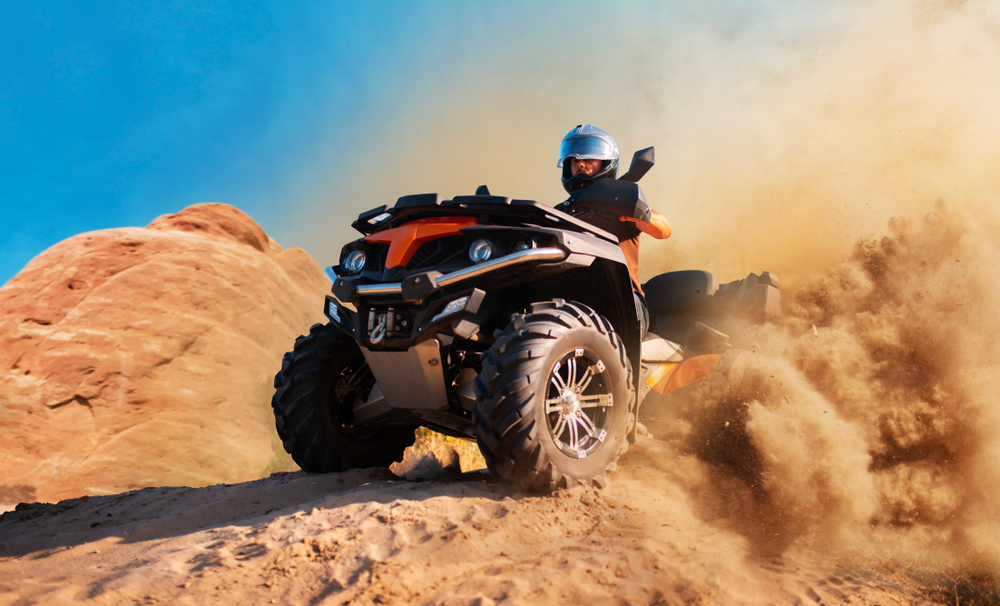
A quad bike is a four-wheeled, off-road motor vehicle steered with handlebars and straddled by the rider like a motorcycle, built specifically to handle rough, uneven, or loose terrain such as sand, mud, gravel, and rocky trails.
Officially known as an ATV (All-Terrain Vehicle), the quad bike gets its everyday name simply from having four wheels (“quad” from the Latin quattuor). It sits in its own category, distinct from motorcycles, dirt bikes, dune buggies, and side-by-sides (UTVs), and it’s become one of the most popular off-road recreational vehicles in the world, nowhere more so than in Dubai’s red desert dunes.
At ESA Tours, quad biking is one of our most requested activities, and it’s not unusual for first-time riders to ask exactly what separates a “quad bike” from an ATV, a dirt bike, or a buggy before they book.
This guide breaks down everything you need to know: what a quad bike is, how it works, the different types available, how it compares to similar off-road vehicles, and what to expect when you ride one in Dubai’s desert.
A quad bike is a motorised, off-road vehicle with four low-pressure tyres, a straddle seat, and handlebar steering, designed for a single rider (or two, on double-seat models) to travel across unpaved or difficult terrain. The term is used interchangeably with ATV, though “quad bike” is more common in the UK, Middle East, and Australia, while “ATV” is the standard term in North America.
Key defining characteristics of a quad bike include:
Because of this design, quad bikes offer excellent manoeuvrability and traction across terrain that a standard car or motorcycle simply cannot handle — which is exactly why they’ve become a staple of desert safari and off-road tourism in places like Dubai.
The modern quad bike traces its roots to the early 1970s, when manufacturers like Honda began experimenting with three-wheeled all-terrain vehicles (ATCs) for off-road recreation and utility work. By the mid-1980s, safety concerns around three-wheeled models, which were prone to tipping, led manufacturers to shift to the four-wheeled design we recognise today.
Honda’s 1985 TRX250 Fourtrax is widely credited as one of the first mass-produced four-wheel ATVs, and from there, brands like Yamaha, Suzuki, Kawasaki, Polaris, and Can-Am rapidly expanded the category into both utility and sport segments.
Today, quad bikes serve two very different markets:
A quad bike operates much like a simplified off-road motorcycle mounted on four wheels instead of two. Here’s how the core mechanics work:
Most recreational quad bikes use a single-cylinder, four-stroke engine ranging from 150cc for entry-level and kids’ models to 700cc+ for high-performance sport quads. Power is delivered to the rear wheels or all four wheels (4×4/AWD), depending on the model.
Most modern rental and recreational quad bikes use an automatic or CVT (continuously variable transmission) system. This means riders generally don’t need to operate a manual clutch or shift gears—just use the throttle and brakes.
Independent front and rear suspension absorbs impacts from dunes, bumps, and uneven terrain. This improves both rider comfort and vehicle control, especially when riding on desert terrain.
Handlebar-mounted controls operate the throttle, usually through a thumb lever, along with the front and rear brakes. Steering feels similar to a motorcycle but benefits from the greater stability of a four-wheel base.
Wide, low-pressure tyres with deep tread provide a larger contact patch on soft sand. This helps prevent the quad bike from sinking and improves traction when climbing sandy inclines.
The combination of a low centre of gravity, wide wheelbase, four-wheel stability, and automatic controls makes quad bikes relatively easy to learn compared with two-wheeled motorcycles or dirt bikes, even for many first-time riders.
This is one of the most common points of confusion for first-time desert safari bookers, so it’s worth clarifying the terminology.
| Vehicle | Seating | Steering | Riders | Best For |
| Quad Bike / ATV | Straddle seat, motorcycle-style | Handlebars | 1–2 | Solo or duo off-road thrill riding |
| UTV / Side-by-Side | Bucket seats, car-style | Steering wheel | 2–6 | Group off-roading with roll cage protection |
| Dune Buggy | Bucket seats, harness-secured | Steering wheel | 1–4 | High-speed dune bashing with roll cage safety |
| Dirt Bike | Straddle seat, two wheels | Handlebars | 1 | Trail riding and motocross-style terrain |
A quad bike or ATV is a four-wheeled, straddle-seat vehicle steered using handlebars. This guide focuses primarily on this type of off-road vehicle.
A UTV, also known as a side-by-side, features car-like bucket seats, a steering wheel, and a roll cage. It typically accommodates two or more passengers.
A dune buggy is a lightweight, open-frame off-road vehicle designed specifically for high-speed dune driving. It usually features a steering wheel, roll cage, and racing harness. You can learn more in our complete dune buggy guide.
A dirt bike is a two-wheeled off-road motorcycle that requires more balance and riding skill than a quad bike.
If you’re deciding between a quad bike and a dune buggy for your Dubai desert adventure, the short version is: quad bikes offer a more raw, hands-on riding sensation with direct handlebar control, while dune buggies offer a faster, more protected, car-like driving experience with a roll cage and safety harness.
Not all quad bikes are built the same. Manufacturers design different models depending on the terrain, rider experience level, and intended use.
Built for speed, agility, and performance riding, sport quads (like the Yamaha Raptor 700cc) feature larger engines, lighter frames, and aggressive suspension tuning. These are the models most desert safari operators use for adrenaline-focused rides across dunes.
Designed for towing, hauling, and working across farmland, construction sites, or rugged terrain. Utility ATVs (like the Polaris Sportsman line) prioritise torque and durability over top speed, and often include racks or towing hitches.
Smaller-displacement models (typically 90cc–180cc) with speed limiters, automatic transmissions, and reduced top speeds, designed to let younger riders experience off-roading safely under adult supervision.
Built with an elongated frame and a second seat behind the driver, allowing a passenger to ride along, a popular option for couples, friends, or a parent riding with a child.
Purpose-built for motocross-style ATV racing, with stripped-down frames, high-performance engines, and racing suspension, generally not used for casual tourism rides.
Desert terrain, particularly the soft, shifting red dunes found in the UAE, presents unique challenges that quad bikes are specifically engineered to handle:
Wide, low-pressure tyres distribute the quad bike’s weight across a larger surface area, helping prevent it from sinking into loose desert sand.
High ground clearance allows the quad bike to travel over dune ridges, dips, and uneven terrain without the underside dragging against the sand.
Lightweight frames reduce the power needed to maintain momentum when riding up steep dune inclines, making the quad more responsive on sandy terrain.
Four-wheel traction provides greater stability on uneven and sloped surfaces, helping riders maintain control when crossing desert side-slopes.
Automatic transmission allows beginners to focus on steering, throttle control, and navigating the terrain without having to manage gears or a manual clutch.
These features make quad bikes well suited to desert riding and help explain why quad biking has become a popular Dubai desert safari activity, alongside 4×4 dune bashing and dune buggy rides.
Quad biking is a generally safe activity when done with a licensed operator, proper safety gear, and guided supervision, but like any off-road motorsport, it carries real risk if approached carelessly. Understanding the basics helps every rider stay safe:
Reputable operators, including ESA Tours, provide a mandatory safety briefing, protective gear, and a guide-led format so that even complete beginners can ride confidently and safely.
In most desert safari and tourism contexts, including Dubai, no driver’s license is required to ride a quad bike on a guided tour. Licensed operators are permitted to take tourists through designated off-road zones after a short safety briefing and practice run. However:
This makes quad biking one of the most accessible adventure activities for tourists, since no prior riding experience or documentation is needed to participate.
Entry-level and kids’ quad bikes typically fall within the 90cc–150cc range. They offer lower power and speed, making them suitable for beginners and younger riders where permitted.
Quad bikes in the 180cc–250cc range are commonly suitable for adult beginners and some double-seat models. They provide a balance between manageable handling and sufficient power for desert riding.
Mid-range 320cc–450cc quads provide stronger torque and performance, making them better suited to riders who want additional power for climbing and navigating sandy dunes.
High-performance quads such as the Polaris Sportsman 570cc and Yamaha Raptor 700cc deliver significantly more power and performance. These models are generally better suited to experienced riders seeking an adrenaline-filled desert adventure.
The ideal engine size depends on your age, riding experience, confidence, and comfort level. Your tour operator or guide can help you choose an appropriate quad bike before the ride begins.
Dubai’s Al Badayer desert, often called the “Big Red” dunes, has become one of the most popular quad biking destinations in the world, thanks to its dramatic red sand formations and accessibility from the city. A typical quad biking Dubai experience includes:
At ESA Tours, our quad bike fleet ranges from the 150cc Sharmax ATV, ideal for first-timers — up to the 700cc Yamaha Raptor for experienced thrill-seekers, alongside two-seater options for couples and friends. Every ride includes safety gear, a guided briefing, and access to our desert camp facilities.
If you’re planning a Dubai desert adventure and trying to decide between activities, here’s a quick way to think about it:
Many visitors combine two or more of these activities in a single desert safari package, which is one of the most cost-effective ways to experience everything Dubai’s desert has to offer in one trip.
Now that you know exactly what a quad bike is, how it works, and what makes it different from a dune buggy or UTV, the next step is simple: experience it for yourself. At ESA Tours, our quad biking Dubai packages take you across the iconic red dunes of Al Badayer with fully guided, safety-briefed rides suited to every experience level, from your first-ever off-road ride to a full-throttle Yamaha Raptor 700cc adventure.
Book your quad bike tour now on WhatsApp: +971 55 873 2018 , or explore our full range of quad bike and ATV packages in Dubai to find the ride that matches your adventure level.

Ashlie is the Camp Manager – Operations at ESA Tours, responsible for managing desert safari and adventure experiences across Dubai. Passionate about desert life and hospitality, she ensures every guest enjoys a safe, comfortable, and unforgettable Arabian journey.